
Nail-biting moments gave way to celebratory mood at the command centre of Indian Space Research Organisation in Bangalore on Wednesday, as its Mars Orbiter Mission or Mangalyaan entered the red planet's orbit.

The 4,700 kg GSAT-N2 High-throughput (HTS) satellite has been injected into the desired orbit, NewSpace India Limited (NSIL) said in a series of posts on microblogging site 'X.

The primary satellite TeLEOS-2 is a synthetic aperture radar satellite developed under partnership between Defence Science and Technology Agency (DSTA) representing the Government of Singapore and ST Engineering.

The Indian Space Research Organisation (ISRO) is set to welcome the new year with the launch of its first X-Ray Polarimeter Satellite that would offer insights into celestial objects like black holes, onboard a Polar Satellite Launch Vehicle rocket on Monday.

India's Group Captain Shubhanshu Shukla and three other astronauts on Thursday reached the International Space Station as the Dragon spacecraft docked with the orbital laboratory.

The mission was originally scheduled for lift-off on May 29 but was put off multiple times when engineers detected a liquid oxygen leak in the boosters of the Falcon-9 rocket and NASA also detected leaks in the ageing Russian module of the ISS.

This is the second of the series conducted at Aeronautical Test Range, Chitradurga, in Karnataka at 7.10 am.

The rocket flight was aborted in order to plug the liquid oxygen leak identified during post-static fire Falcon 9 rocket inspections.

India scripted history by successfully launching EMISAT, a military satellite, and 28 foreign nano satellites on-board its polar rocket from Sriharikota on Monday, in a complex mission which marked many a first for Indian Space Research Organisation.

At least 17 different tests are planned by ISRO next year before it carries out the unmanned space flight in December next year.

Microsat-R, an imaging satellite, is meant for military purposes, but the ISRO did not give any details about it.

While the mission is a follow-up to the PSLV-C55 TeLEOS-2 mission launched in April this year, scientists in Sunday's mission will place the fourth stage of the PSLV rocket in a lower orbit.

This is the first mission by the Indian Speace Research Organisation this year.
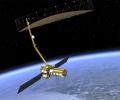
NISAR will not be used for surveillance and will be used to observe the earth.

The ISRO on Sunday scripted yet another history after its LVM3 rocket successfully placed 36 satellites of United Kingdom-based OneWeb group company into intended orbits.
'The benchmark was set by Dr Sarabhai.' 'If there is a problem, everybody would be encouraged to come up with a solution.' 'The final solution will be the result of all the inputs.' 'This is passed on through time.' 'Even today, you see that nobody wants to take particular credit on a success.'

'The real story of 2025 is that India officially stopped being a 'market of the future' and started acting as the world's primary economic engine.'
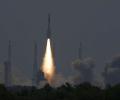
The Indian Space Research Organisation (ISRO) on Monday successfully launched a second generation navigation satellite, using a GSLV rocket with a cryogenic upper stage to do the job.

ISRO said the upper stage of the Polar Satellite Launch Vehicle - C37 (PSLV-C37) re-entered the earth's atmosphere on October 6, 2024 and the impact point was the North Atlantic Ocean.

When asked if it would be possible to achieve the Gaganyaan mission with the given time frame, Sivan said, "Yes, we are not doing this for the first time, and we are also not starting the mission from the scratch. We are already on the job," adding that several important procedures, like the crew module, crew escape systems, environment control and life support systems, had already been completed.

'We started AgniKul to show that space transportation should be as simple as road transportation.'
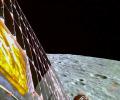
As scientists at the Indian Space Research Organisation (ISRO) gear up for the much-awaited soft landing of the Chandrayaan-3 spacecraft on the Moon's surface, the space agency may postpone the touchdown to August 27 in the event that health parameters of the lander module are found to be "abnormal", a senior official has said.
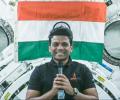
Group Captain Shubhanshu Shukla, the first Indian astronaut at the International Space Station (ISS), conducted a critical biomedical experiment aboard the ISS on flight day 6 of the Axiom 4 Mission, focusing on how microgravity contributes to muscle loss.
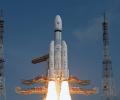
The mission is targeted for launch in the fourth quarter of 2024.

The mission objective is to ensure data continuity of ocean color and wind vector data to sustain the operational applications.

ISRO's first mission in 2023 and SSLV's sequel saw a strange coincidence--it was launched at 9.18 am, the same time its predecessor lifted off from the Satish Dhawan Space Centre here on August 7, 2022 but could not deliver due to orbit anomaly and flight path deviation.

ISRO launched 12 Indian, 22 foreign satellites and successfully flight-tested India's first winged-body aerospace vehicle.

Indian Space Research Organisation's second mission of the year to place an earth observation satellite by a GSLV rocket faced a setback as the mission could not be accomplished fully due to performance anomaly in the cryogenic stage of the rocket, the space agency said on Thursday.

Cartosat-3 satellite is a third-generation agile advanced satellite having high-resolution imaging capability.

A day after suffering a glitch during the fourth orbit raising operation on its Mars Orbiter Mission, the Indian Space Research Organisation on Tuesday successfully completed the supplementary manoeuvre, raising the spacecraft's apogee (farthest distance from Earth) to over 1,18,000 km.
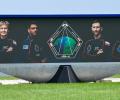
SpaceX, National Aeronautics Space Administration (NASA) and Axiom Space are closely watching weather patterns at the Kennedy Space Centre in Florida where Indian astronaut Shubhanshu Shukla and three others look forward to their travel to the International Space Station (ISS), now scheduled for Wednesday.

Indian Space Research Organisation's plan to soft land Chandrayaan-2's Vikram module on the Lunar surface did not go as per script in the early hours of Saturday, with the lander losing communication with ground stations during its final descent.

The entire mission operations of Chandrayaan-3, right from the launch till landing, "happened flawlessly" as per the timeline, the team that led India's third mission to the Moon said on Wednesday.

Meet Indian Space Research Organisation scientist Ningthoujam Raghu Singh, who was one of the bright sparks responsible for sending Chandrayaan-3 to the moon.

Around 23 minutes after lift-off, the primary satellite got separated and it was followed by six other co-passenger satellites, which were deployed into the intended orbits sequentially, ISRO said.

It has already tasted success with the moon mission and Mangalyaan. Is man in space the next frontier for ISRO?

The RISAT-2B would replace the RISAT-2, which has been actively used by India to monitor activities in camps across the border in Pakistan to thwart infiltration bids by terrorists.

ISRO chairman S Somanath said the success gave the space agency "greater confidence," as the GSLV will be next deployed in the NISAR mission, a collaborative effort with the US' NASA.
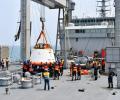
Nerves gave way to smiles at the spaceport in Sriharikota as delays and an anomaly-triggered 'hold' forced Indian Space Research Organisation (ISRO) scientists to revise the launch schedule of a test vehicle carrying payloads related to the country's ambitious human space flight mission, Gaganyaan which soared into skies after initial hiccups.
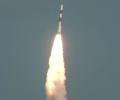
The launch marks a significant milestone for the space agency as it is the 50th flight of PSLV and the 75th vehicle mission from Sriharikota. The 628 kg satellite is meant for applications in various fields like agriculture, forestry and disaster management support. It would also serve military purposes.
